Saved EURUSD test · Open loss across midnight
$176.82 still open: does midnight erase your challenge loss?
Your open loss does not disappear when the challenge day changes. In our saved EURUSD test, one position still carried a $176.82 loss just after midnight Berlin on 19 May 2025. The frozen daily rule used a $500 allowance from the day-start balance. The position stayed inside that floor at this instant, but the loss still counted. Check your open trades beside your reset rule.
The question behind the new date
A trader asked whether a new challenge day erases an existing open loss. It is easy to see why the question comes up. Your report starts another daily row. The chart displays another date. Yesterday's closed trades move into yesterday's history. But an open position has not closed just because the clock changed.
Our saved case keeps that same position on both sides of midnight. We did not move money into the account, close the trade or choose another trade to make the new day look better. We compared the account values immediately before and after the reset. The difference between closed balance and account value including the open trade tells the story.
What remained on the account
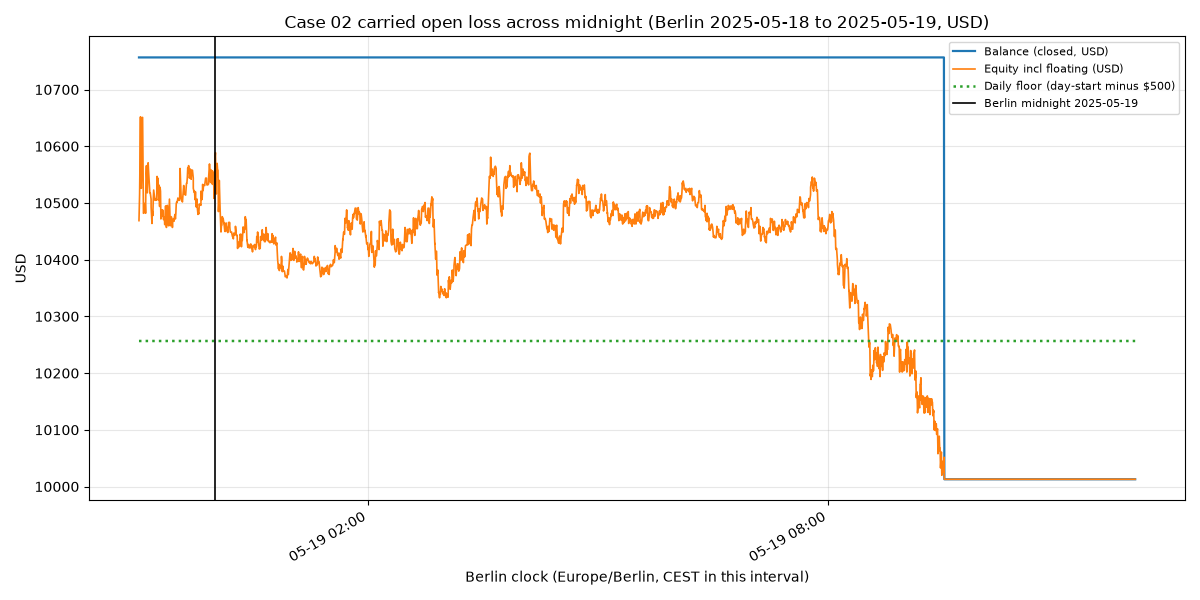
The closed balance was $10,756.64 on both sides. Before midnight, the account value including the open trade was $10,529.82. Just after midnight, it was $10,579.82. The floating loss was therefore still present: $226.82 before, $176.82 after. Those amounts are quoted from the saved case, including its stated costs.
The loss became smaller at the second reading because the price changed. Midnight itself did not pay the loss back. A trader who sees the new daily row and ignores that open position would miss money that is already at risk.
The chart shows the saved account path in dollars, with Berlin time and the daily floor beside it. It is the actual chart from this run. The floor uses the closed day-start balance in this frozen example, rather than replacing that balance with the lower account value including the open loss.
The floor did not become easier
The daily floor was $10,256.64 on both sides of this reset: the $10,756.64 day-start balance less the frozen $500 allowance. Just after midnight the account still had $323.18 above that floor. This selected instant did not breach the daily rule. Its point is that the open loss carried into the next day.
Using the lower reset account value as the starting balance would have produced a mistaken floor of $10,079.82. That would make the rule look easier by the very $176.82 loss still on the position. Before relying on a reset, name the value your rule actually starts from. Balance, account value including open trades and a previous peak answer different questions.
What this run can answer
This was an EURUSD historical simulation using generated price steps from one-minute candle opens, highs, lows and closes. It included trading and overnight costs. The selected clock mapping used server time one hour ahead of Berlin during the tested summer interval. The chart is a saved explanatory example, with that mapping stated beside it.
The full simulation had already hit a daily loss limit earlier, on 6 May. The later midnight case comes from a continued explanatory run, rather than a still-valid challenge account. It explains how a carried position and a balance-based daily floor interact. It does not establish that this strategy passed a challenge.
Check the position that crosses your reset
Keep your own account rule, its reset timezone and the value used to set its floor together. Then read the open trade on both sides of that exact time. Include costs in the account value used by the rule, and avoid subtracting them twice. If your program only sees a new date, this is the missing check to give it.
The companion reset-clock case explains why choosing another clock changes which daily floor applies. The cash-risk check keeps position size beside an actual money allowance.
Send your rule sheet or trading program for the free Challenge Pre-Check. Start with the account value, open position and reset rule you actually use.
Sources and related guides
Start with your own rules
Send your rule sheet or trading program for one rule sheet to confirm.
Free Challenge Pre-Check →