Saved EURUSD test · Daily reset
FTMO daily reset time: one hour moved our floor by $1,380.91
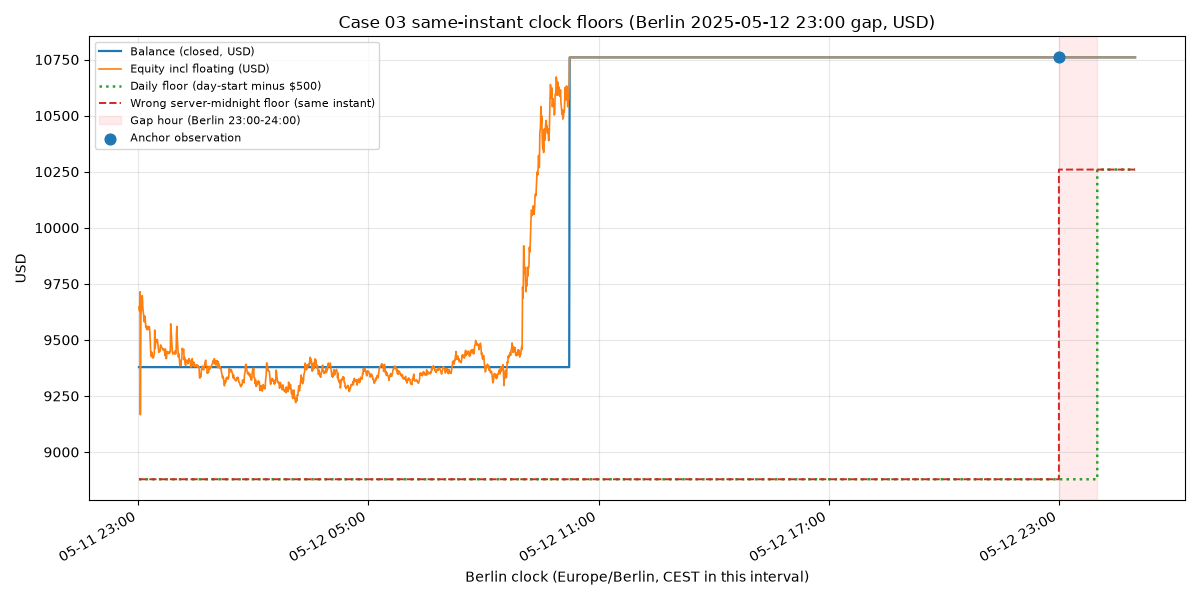
Your broker's new day can arrive before your challenge's new day. In my saved EURUSD simulation, choosing server midnight instead of Berlin midnight moved the daily loss floor by $1,380.91 at the same instant. The account stayed above both floors at that point. The lesson is the clock: check the reset named in your rules before treating a date change on your chart as fresh daily room.
The question behind the check
A trader asked why the daily loss had not reset after the trading log showed a new date. That is a useful question for anyone holding a position near a daily limit. Your chart, account report and challenge dashboard may label the same moment with different dates. A new date in one report does not establish that the challenge has started its next day.
The current FTMO 2-Step rule names 00:00 CE(S)T for its daily recalculation. It takes the balance at that reset and subtracts the daily allowance. Equity, which includes open positions and charged costs, must stay above that floor. The separate 1-Step rules have a different daily allowance, so keep the exact product beside the reset time rather than borrowing a percentage from another account.
One saved moment, two different floors
I inspected a saved EURUSD run with the same saved account values grouped by two clocks. The intended grouping used Berlin midnight. The comparison used the server date changing at midnight. In the observed period, the saved history aligned best with a server clock one hour ahead of Berlin.
At Berlin 23:00 on 12 May 2025, the server clock already showed 00:00 on 13 May. The account balance and equity were both $10,759.64, with no position open. Under the Berlin grouping, the day's starting balance was $9,378.73 and the daily floor was $8,878.73. Under the server-midnight grouping, the new starting balance was $10,759.64 and the floor was $10,259.64.
Both checks used the saved $500 daily allowance. The price and account value had not changed between the two comparisons. Only the day assigned to that moment had changed. The two floors were $1,380.91 apart. That is why a timezone setting deserves the same attention as the loss percentage.
What the chart does and does not answer
At the marked moment, equity was above both floors. This example does not show a breach caused by the wrong clock at that moment. It shows a changed boundary under the same account value. Reading a larger gap between floors as a proven failure would add a conclusion the saved row does not support.
The example was selected because it exposed the largest difference between the two floors in the comparison hour. It is an explanation of the reset calculation, rather than a typical trading day. Commissions and swaps were already in the tester's balance and equity figures. I kept those values and did not subtract the same costs again.
Keep a reset check with your own report
Start with the account's named timezone, reset time and product. Save one account snapshot immediately before that reset and one immediately after it. Keep the original server timestamp too. That lets you check the conversion without losing the clock your platform actually recorded.
Then keep the day's starting balance, current balance, current equity and daily floor together. If a position crosses the reset, keep its open result on both sides. Resetting the day does not close the position or erase its current loss. The saved floor and the open result answer different parts of the account question.
For another view of that difference, read the balance and equity case. You can also compare the stated data limits of our saved strategy tests. For your own account, the free Challenge Pre-Check starts with your platform, account size and exact daily rule.
This was a continued historical simulation after its first breach, using ticks generated from minute candles and an empirically aligned history clock, not official broker timezone confirmation or a forecast for your account.
Sources and related guides
Start with your own rules
Bring your platform, account size and exact daily rule. Keep the reset clock beside the loss percentage.
Free Challenge Pre-Check →