EURUSD historical simulation · Open position at reset
$177 still open: does midnight erase your challenge loss?
Your new trading day does not erase the loss on an open position. My MT5 simulation still carried a $177 open loss after midnight, with about $323 above its daily floor. I carry the open position across the reset instead of treating the new date as a fresh account. Check the balance used to set your floor before paying for a challenge.
What the trader asked
A trader described a position held over several days and asked why its accumulated open loss could still trigger a daily limit. The thread contains conflicting answers. A new date in your report can make yesterday's loss feel finished, even though the position has never closed. Start with the firm's current written rule and its account model. A forum reply cannot replace either of those.
I checked FTMO's current 2-Step Maximum Daily Loss description on 19 October 2026. It compares equity, including open positions and charges, with a floor recalculated at midnight CE(S)T from balance less 5% of initial capital. That is a balance-based reset. Replacing balance with equity would create a different rule. Other account models need their own current description.
One position, two readings
I used an EURUSD one-hour historical simulation in MetaTrader 5, with a $10,000 initial balance and one-lot positions. The run covered May through September 2025 using generated price steps from one-minute candle data, with spread, commission and swap included. The retained log and chart keep the exact amounts. Dollar figures here are rounded for reading.
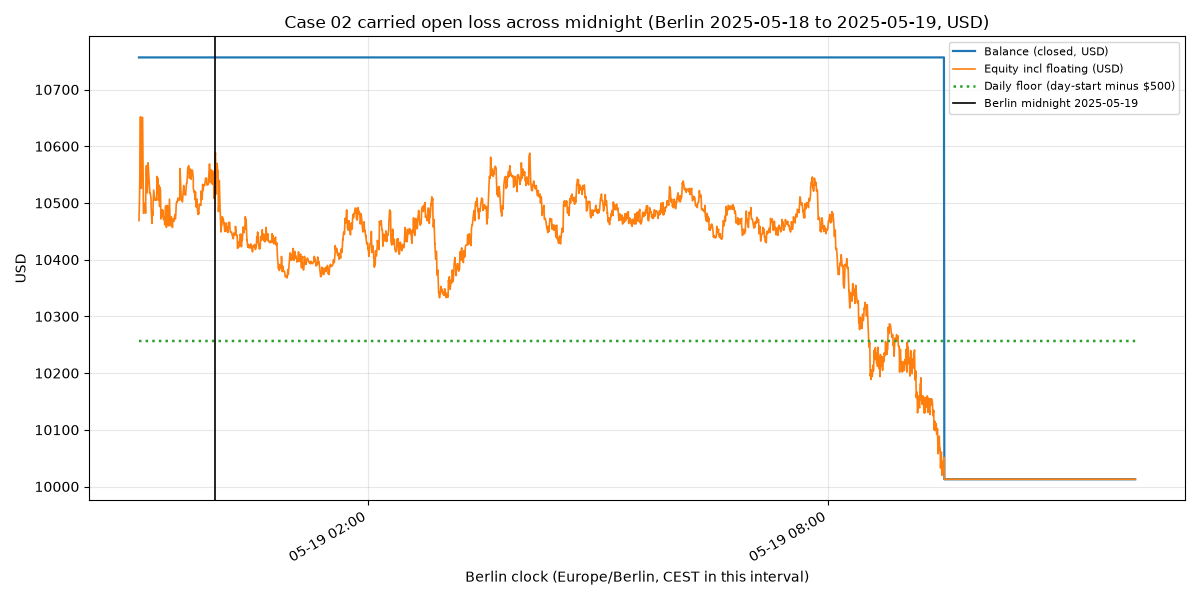
The selected position was open on both sides of midnight Berlin on 19 May. Its floating loss was about $227 before midnight and $177 just after. Closed balance did not change between those readings. The smaller second loss came from the price movement between the two samples. The new date did not close the trade or return the money.
The chart keeps balance, equity and the daily floor separate. Balance records the closed result. Equity includes the position that is still moving. When you read only the balance line, the open loss is easy to miss. When you read only the new daily row, the same mistake can look like a successful reset.
The floor stayed in place
In this example the closed balance was about $10,800. The daily allowance was $500 from the original $10,000 start. The retained exact calculation gave the same floor on both sides of this midnight. Just after the reset, equity was about $323 above that floor. This particular reading did not breach the daily limit.
If I had reset the floor from the lower equity instead, I would have made the permitted floor easier by the open loss itself, about $177. That would hide part of the loss by changing the starting value. A correct subtraction cannot rescue the wrong starting value. Keep the value named in the account rule beside the calculation.
Give the reset an actual clock
The selected summer interval used server time one hour ahead of Berlin. That mapping belongs to this example. Do not copy the offset into another broker or winter interval without checking it. Record the reset timezone and compare the samples that actually straddle that reset. Server midnight and the firm's midnight can select different account balances.
Keep charges in the equity value the rule uses, and avoid subtracting them twice. Preserve the open position identifier as well. If your export has silently closed and reopened a position, you are no longer comparing the same state across the boundary.
Check your own report
Find one position open across your reset. Compare its balance, equity and daily floor on both sides, using the timezone in your own rule sheet. Write down whether the floor uses balance, equity, an earlier peak or another named value. Then calculate the money allowance separately from the open result. If your export has only daily closing values, mark the unseen intraday path as unknown.
The free Challenge Pre-Check starts with your rule sheet and the values your program can actually record. The reset-clock example shows why choosing another clock can change the floor at the same instant.
This historical simulation continued after an earlier breach on 6 May; it illustrates the carried loss and does not show a surviving challenge or live broker fills.
Sources and related guides
Start with your own rules
Send your rule sheet or trading program for one rule sheet to confirm.
Free Challenge Pre-Check →