Saved commodities test · Daily loss
A $442 losing day: why a daily chart cannot clear your challenge
Your daily chart can finish inside a loss limit while leaving one part unanswered. In my saved commodities test, the worst daily return was -4.4213%. On a $10,000 comparison base, that is $442.13 down. Beside an example $500 daily allowance, it looks inside the line. But your challenge may check account value while trades are still open. A daily closing value cannot show every value checked during that day.
The belief: the closing loss is the whole day's risk
You have probably seen a report with a row for each day. It is easy to read the worst row as the maximum trouble your account could have had. That works only for the value and frequency actually recorded. If the rule checks open losses during the day, one closing row leaves a gap.
The question behind this case came from a trader asking whether daily drawdown or a consistency rule creates more trouble. Before choosing which number matters most, I would ask what the report measures. Drawdown is a fall in account value. A daily loss limit needs a named starting value and reset time. A consistency rule measures something else, so it deserves a separate check.
What I actually tested
The saved rule used last month's Australian-dollar information to choose a direction in gold, silver and oil. Only the previous fully closed month could affect that choice. The historical test covered 2017 through 2023, with transaction costs and overnight financing included. The rule and position exposure stayed fixed across the two sections.
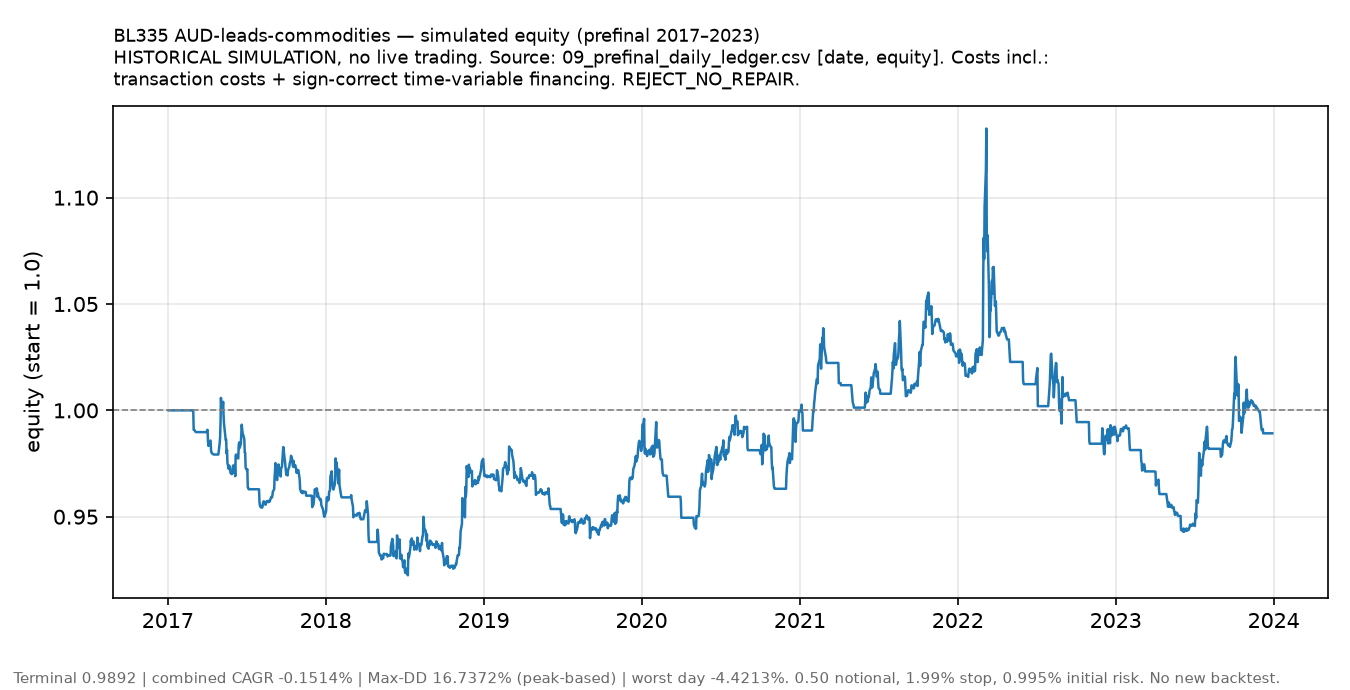
The chart with this case plots the daily account values saved by that run. It shows the path between the beginning and the end, including the deepest fall from an earlier high. It is useful for finding a losing stretch to inspect. Its daily sampling is also the reason it cannot settle a question about every moment inside that stretch.
One losing day, three different questions
The worst daily return was -4.4213%. The deepest fall from a previous peak was 16.7372%. The combined annual rate was nearly flat at -0.1514%. These are three different measurements. A nearly flat ending did not remove the losing day or the deeper valley along the way.
The $442.13 figure translates that worst daily percentage onto a stated $10,000 reference value. It is not a claim that a real funded account lost that exact amount. The percentage uses the previous daily account value as its base. An example $500 allowance uses 5% of a $10,000 starting account. Those bases need to be kept beside their numbers.
Now imagine that your report has only the daily closing values. You can compare the recorded close with your chosen line. You still cannot read an unrecorded intraday low from that row. A later recovery would make the closing loss smaller without proving that the account stayed above its line earlier.
What to keep with your own report
Start with one losing day, rather than the headline profit figure. Save the rule's reset time, its reference balance, the permitted cash loss and the account value including open positions. Keep charged commissions and overnight costs in the value your rule actually checks.
Then inspect the day at the frequency needed by that rule. If the rule applies during open trades, keep the account values throughout those trades. Mark missing intervals instead of silently filling them. If your export contains only daily values, say that clearly and leave the intraday question open.
You can also compare this with the balance-versus-equity case. Balance records closed results. Equity includes the current open result. Knowing which one your rule checks is as important as knowing the percentage.
Your next step
Put your exact account rule into the free Challenge Pre-Check. Keep one losing day's report beside it. The useful answer is a clear list of values you have and values your check still needs.
This was a historical simulation of a rejected rule, not a forecast or a completed funded-account challenge check.
Sources and related guides
Start with your own rules
Keep your exact rule beside one losing day and identify the missing account values.
Free Challenge Pre-Check →